

DUAL DEGREE PROJECT — GNSS ANTENNAS
A Compact Circularly Polarized Filtering Antenna Using AMC for GNSS Applications
Designing an L-band crossed bow-tie antenna backed by an artificial magnetic conductor (AMC), aiming to combine circular polarization, low profile, high gain, and out-of-band radiation suppression. The project explores reflection-phase engineering, antenna–reflector spacing, and the tradeoff between axial ratio and filtering performance.

Simulation evidence
CLICK ANY FIGURE TO ENLARGE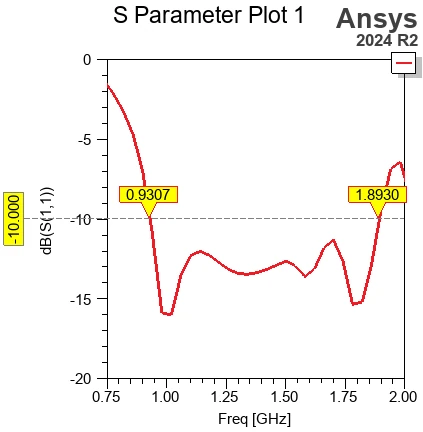
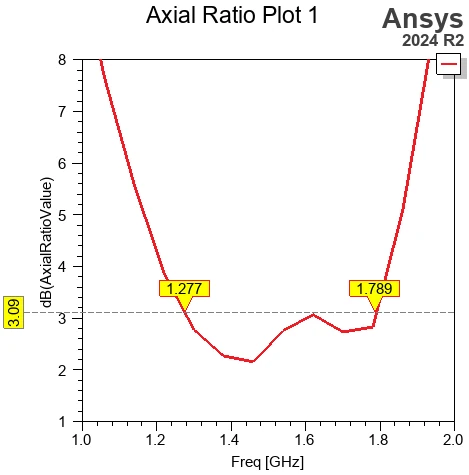
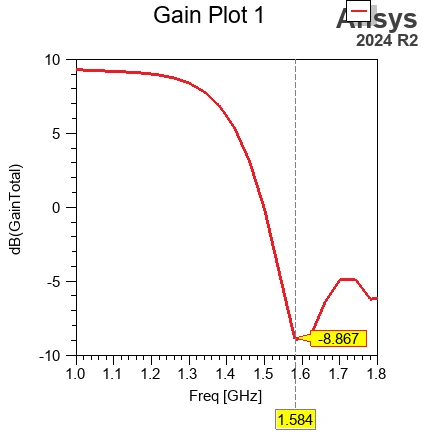
Explore the design iterations and tradeoffs
What the simulations reveal
The 36 mm AMC-backed iteration shows an upper-band radiation null with approximately 29 dB gain suppression; reducing the profile to ~30 mm changes the rejection and axial-ratio response. I compared different reflector gaps to understand those sensitivities, rather than treating one performance number as representative of every geometry.
Still in progress: improving lower-side out-of-band suppression while retaining circular-polarization coverage. These are simulation results, not measured fabricated-antenna data.
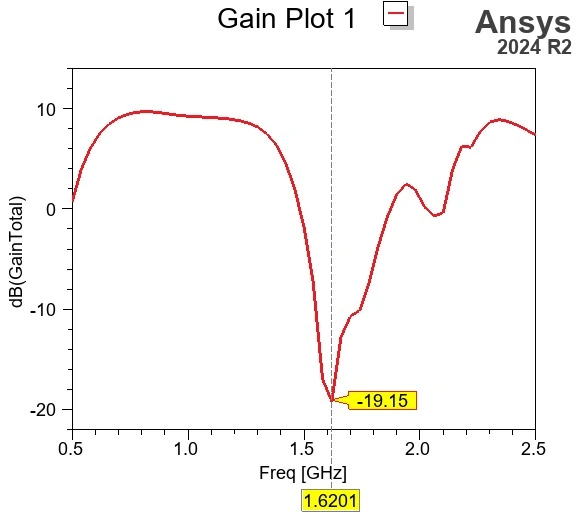
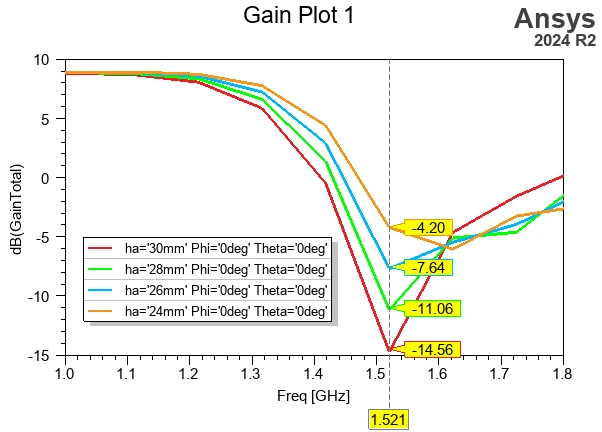
Simulation results are shown for distinct antenna iterations; figures from the 30 mm and 36 mm designs should not be interpreted as results from a single configuration. No fabricated-antenna measurements are claimed.